








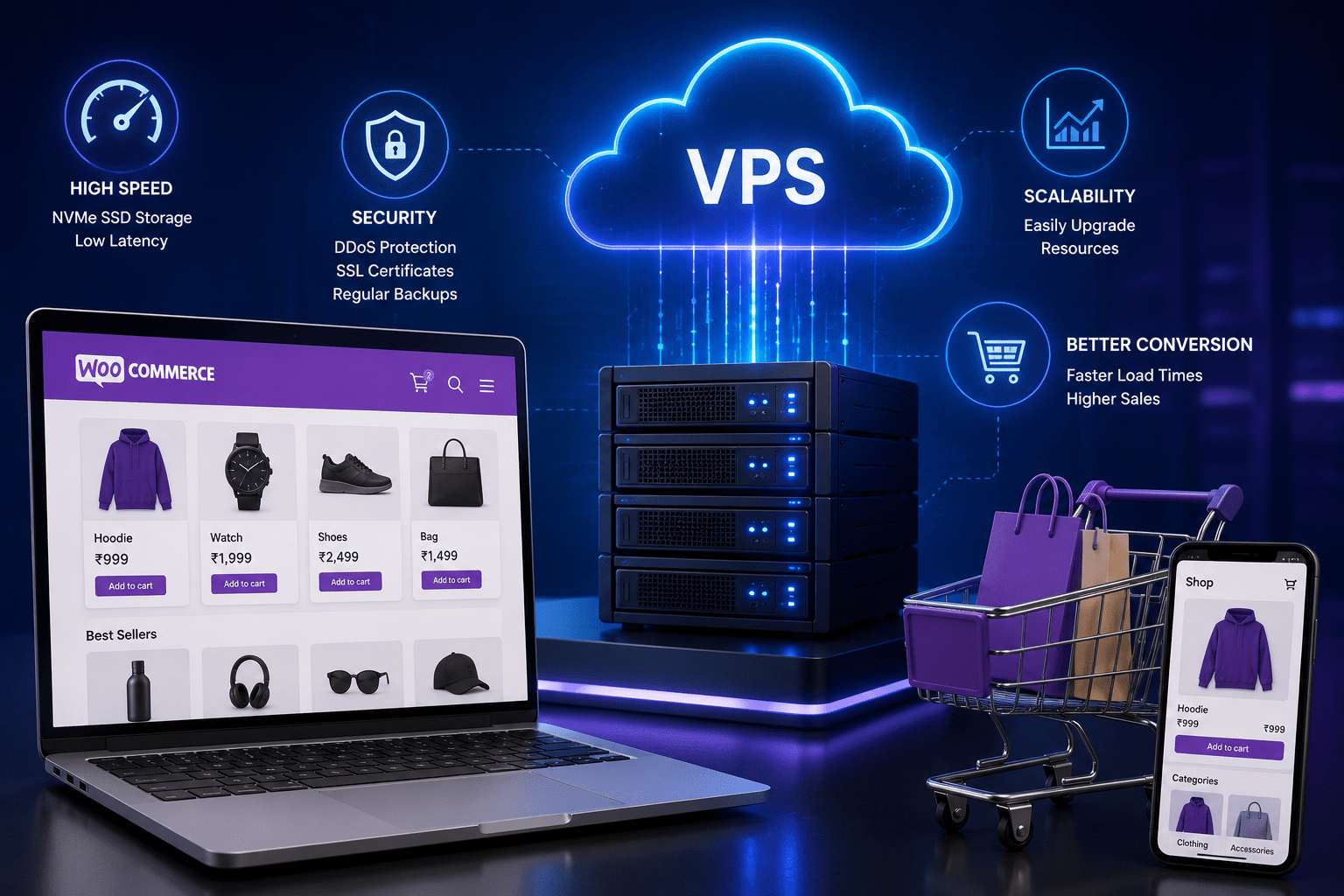


In the competitive Indian e-commerce landscape, where a 100ms delay in page load can slash conversion rates by 7%, the choice of infrastructure is a business-critical decision. For high-growth brands using WooCommerce, standard shared hosting is often the primary bottleneck to scaling. To move from a handful of daily orders to a high-volume storefront, you require the best VPS for ecommerce websites India—a platform that balances raw NVMe performance with the rigorous security standards required for modern digital trade.
What is the Best VPS for eCommerce in India?
The best VPS for ecommerce websites in India must offer local data residency, NVMe SSD storage for rapid database queries, and dedicated KVM-based resources. Specifically for WooCommerce, a VPS with at least 4GB of RAM and AMD EPYC processors ensures that dynamic cart calculations and checkouts remain instantaneous during high-traffic events like Diwali sales, directly preventing cart abandonment.
The Performance-Conversion Connection: Why Speed is Your Best Salesperson
For an online store, speed is not just a technical metric; it is a psychological trigger for trust. When an Indian shopper on a 4G/5G mobile connection clicks “Add to Cart,” the backend database must execute multiple read/write operations instantly.
Eliminating Latency with Local Infrastructure
Using ecommerce website hosting India with servers physically located in Delhi NCR or Mumbai reduces the Time to First Byte (TTFB) significantly. While offshore hosting might seem cheaper, the physical distance causes “latency lag,” which frustrates users and triggers higher bounce rates. Local peering with major Indian ISPs ensures that your product images and scripts load in the blink of an eye.
The Power of NVMe for WooCommerce
WooCommerce is database-intensive. Every time a user filters products or checks inventory, the server hits the database. Traditional SATA SSDs can become a bottleneck during these peaks. WooCommerce hosting India powered by NVMe (Non-Volatile Memory Express) provides up to 10x the throughput of standard drives, ensuring that even stores with thousands of SKUs remain responsive.
Security Infrastructure: Protecting the Transactional Journey
In 2026, e-commerce security is a legal and operational mandate. With the Digital Personal Data Protection (DPDP) Act in full effect, Indian businesses face significant penalties for data breaches.
- PCI-DSS Readiness: While your payment gateway handles the actual card data, your hosting services for online store must provide an environment that supports PCI compliance. This includes dedicated IPs, isolated environments, and encrypted data-at-rest.
- WAF (Web Application Firewall): A VPS allows you to implement a robust WAF that filters out SQL injection and Cross-Site Scripting (XSS) attacks—the most common threats to WooCommerce stores.
- DDoS Mitigation: E-commerce sites are prime targets for extortion-based DDoS attacks. Professional VPS hosting includes network-level scrubbing to ensure your “Open” sign stays lit even under attack.
Comparing Hosting Architectures for eCommerce
Choosing the wrong plan can lead to “Internal Server Errors” during your biggest sales. Here is how VPS stacks up against other models for Indian sellers.
| Feature | Shared Hosting | Cloud VPS (e.g., Ocloudi) | Dedicated Server |
| Performance | Unpredictable / Shared | Consistent & Dedicated | Maximum Power |
| Scaling | Difficult / Limited | Instant (Vertical Scaling) | Hardware Dependent |
| Security | Risk of “Noisy Neighbors” | Isolated Environment | Full Physical Isolation |
| Price (INR) | Low | Mid-Range (High ROI) | High |
| Best For | Personal Blogs | Growing eCommerce Brands | Large Enterprises |

Technical Essentials for a Scalable Online Store
To ensure your hosting services for online store can handle growth, verify these architectural requirements:
- KVM Virtualization: Ensure your VPS uses KVM (Kernel-based Virtual Machine) rather than OpenVZ. KVM offers “hard” resource allocation, meaning other users on the same physical hardware cannot “steal” your RAM or CPU cycles.
- Object Caching (Redis/Memcached): WooCommerce stores benefit immensely from Object Caching, which stores database query results in RAM. Ensure your VPS environment supports Redis for a snappier admin dashboard and faster front-end.
- Automated Snapshots: In the fast-paced world of e-commerce, a botched plugin update can cost thousands in lost sales. Weekly or daily snapshots allow you to revert your entire server to a working state in minutes.
- High-Bandwidth Uplink: For high-traffic Indian stores, a 1Gbps port is essential to prevent “queuing” of user requests during peak hours.
Expert Insight: Many “Managed WordPress” hosts are just glorified shared environments. A true best VPS for ecommerce websites India gives you root access, allowing you to optimize the server-level configuration (like PHP-FPM limits) specifically for your store’s unique traffic patterns.
Strategic Benefits of Hosting in India
Beyond speed, there are logistical and financial reasons to keep your infrastructure local.
Billing in INR and GST Compliance
Fluctuating exchange rates can make US-based hosting costs unpredictable. Local providers like Ocloudi offer billing in Indian Rupees, allowing for better financial planning and the ability to claim GST input tax credits, which is a direct 18% saving for registered businesses.
DPDP Act Compliance
The Indian government’s data sovereignty rules require certain types of user data to be stored within national borders. By utilizing ecommerce website hosting India, you simplify your compliance roadmap and build trust with privacy-conscious consumers.
Optimized for Conversion: The Ocloudi Advantage
Ocloudi’s VPS architecture is specifically engineered for the high-concurrency needs of WooCommerce and custom e-commerce platforms.
- AMD EPYC Performance: We utilize the latest generation processors to ensure that heavy PHP processes (like the WooCommerce checkout) are handled without lag.
- 99.9% Uptime Guarantee: We understand that every minute of downtime is a direct loss of revenue. Our redundant network ensures your store stays accessible 24/7.
- Scalability on Demand: Start with our “KVM 1” for your launch and scale to “KVM 8” as your SKU count and traffic grow—without ever migrating your data.
Conclusion: Don’t Let Your Hosting Be a Growth Ceiling
In the world of online retail, your server is your storefront. A slow, insecure server is the equivalent of a store with a jammed door and no security guard. Transitioning to a secure VPS hosting for startups or an established e-commerce VPS is an investment that pays for itself through improved SEO rankings, higher customer trust, and, ultimately, more completed transactions.
Next Steps:
- Test your current TTFB: Use tools like PageSpeed Insights focusing on the India region.
- Audit your plugins: Heavy plugins require more RAM. If you are using 20+ plugins, ensure your VPS has at least 4GB to 8GB of RAM.
- Deploy Locally: Switch to a Delhi-based server to see an immediate improvement in mobile shopping performance.
Frequently Asked Questions (FAQ)
While both are good, a KVM VPS offers more predictable performance for a fixed price. Cloud Hosting is often billed based on usage, which can lead to “bill shock” after a successful marketing campaign. A VPS gives you the same dedicated resources with more budget control.
For a store with over 1000 SKUs and moderate traffic, we recommend a minimum of 4GB to 8GB of RAM. This ensures that database indexing and search filters remain fast and do not crash the PHP process.
Most professional providers, including Ocloudi, support Let’s Encrypt, which provides free, automated SSL certificates. For e-commerce, ensuring your site shows the “padlock” icon is mandatory for processing payments via gateways like Razorpay or PayU.
Yes. Most VPS providers offer migration assistance. Since a VPS gives you root access, the migration process usually involves moving your files and database via SFTP and updating your DNS settings to point to your new Indian IP address.
Google uses “Core Web Vitals” as a ranking factor. Hosting in India lowers your LCP (Largest Contentful Paint) for Indian users, which directly improves your search engine rankings for local queries like “buy [product] online India.”
AMD EPYC processors have a higher core count and better multi-threading performance compared to older chips. This allows the server to handle many simultaneous shoppers (concurrency) without slowing down individual user sessions.
While not strictly necessary if you have a managed service, root access allows your developers to install specific optimizations like Varnish cache, custom Redis configurations, or specialized security modules that aren’t available on shared platforms.
If your customers are primarily in India, a local VPS is extremely fast. However, a CDN (Content Delivery Network) is still useful for serving static assets (images/CSS) even faster and providing an extra layer of DDoS protection.
On shared hosting, if another website on your server gets a massive traffic spike or is hacked, it can slow down or crash your site. A VPS uses virtualization to ensure your resources are locked to your store only, eliminating this risk.
Ocloudi provides automated weekly backups and manual snapshot capabilities. This ensures that before you make any major changes to your WooCommerce settings, you have a “safety net” to restore your business in seconds.
