













For an Indian startup, the transition from a local development environment to a live production server is a high-stakes pivot. In the Delhi NCR tech corridor and across India’s burgeoning hubs, technical founders often grapple with a critical dilemma: opting for cheap shared hosting that crashes under moderate traffic or overpaying for complex hyperscale clouds that drain seed capital. The middle ground—secure VPS hosting for startups—is frequently misunderstood as a mere commodity.
However, a Virtual Private Server (VPS) is not just “part of a server.” It is the foundation of your deployment pipeline, your data security posture, and your user experience. If your server latency in Bangalore is high because your “India-focused” host is actually routing through a data center in Oregon, your conversion rates will suffer. This guide breaks down the first principles of selecting a scalable server for fast-growing businesses, focusing on the unique infrastructure requirements of the Indian market.
What is the Best VPS Hosting for Startups in India?
The ideal hosting for startups in India must offer a “Sovereign Cloud” experience: local data residency for compliance, low-latency connectivity via National Internet Exchange of India (NIXI) peering, and hardware-level security. Startups should prioritize managed VPS solutions that allow instant resource scaling (RAM and CPU) without IP address changes, ensuring 99.9% uptime during rapid growth phases.
1. The Architecture of Scalability: Why VPS Trumps Shared and Dedicated Options
Startups exist in a state of constant flux. A marketing campaign could trigger a 500% traffic spike in minutes. Shared hosting lacks the resource isolation to handle this, while dedicated servers are too rigid and expensive for early-stage budgets.
The Logic of Virtualization
A VPS uses a hypervisor (like KVM) to carve a physical server into multiple isolated virtual machines. Unlike shared hosting, where a neighbor’s script error can take down your site, a VPS provides dedicated resources. For an Indian startup, this isolation is the first line of defense against “noisy neighbor” syndrome and localized DDoS attacks.
Why Local Latency Matters
In the context of hosting services for startups in India, physical distance is the enemy of speed. Every 100ms of latency can result in a 7% drop in conversions. By utilizing a cloud server for startups India located in regional hubs like Delhi NCR or Mumbai, you bypass the bottlenecks of international undersea cables.
2. Security Protocols: Protecting Your Intellectual Property
Security is not an add-on; it is a core server requirement. Startups often handle sensitive user data (KYC, payment info, or proprietary algorithms) that require more than just a standard SSL certificate.
- DDoS Mitigation at the Edge: Modern VPS providers must offer multi-layered DDoS protection. This involves scrubbing malicious traffic before it reaches your virtual environment, ensuring that your “Secure VPS hosting for startups” remains accessible even during an attack.
- Kernel-Level Hardening: Look for providers that implement security-enhanced Linux (SELinux) or AppArmor. These frameworks restrict how programs interact with each other and the system, containing potential breaches.
- Automated Off-site Backups: A backup stored on the same physical disk as your production environment is a single point of failure. Professional hosting ensures data is replicated across geographically distinct zones.
Pro Tip: Always verify if your provider offers “Snapshot” capabilities. This allows you to take a “photograph” of your entire server state before a major deployment, enabling a one-click rollback if the code breaks.
3. Comparing Infrastructure: Cloud vs. Traditional VPS
When searching for a cloud server for startups India, it is vital to distinguish between a standard VPS and a Cloud VPS.
| Feature | Standard VPS | Cloud VPS (Ocloudi Model) |
| Storage | Single Physical Disk | Distributed SSD/NVMe SAN |
| Scaling | Manual Reboot Required | Instant “On-the-fly” Scaling |
| High Availability | No (Tied to 1 Hardware) | Yes (Automatic Failover) |
| Performance | Predictable | High-Performance (IOPS) |
| Best For | Static Apps/Dev Sites | High-Traffic SaaS & E-commerce |
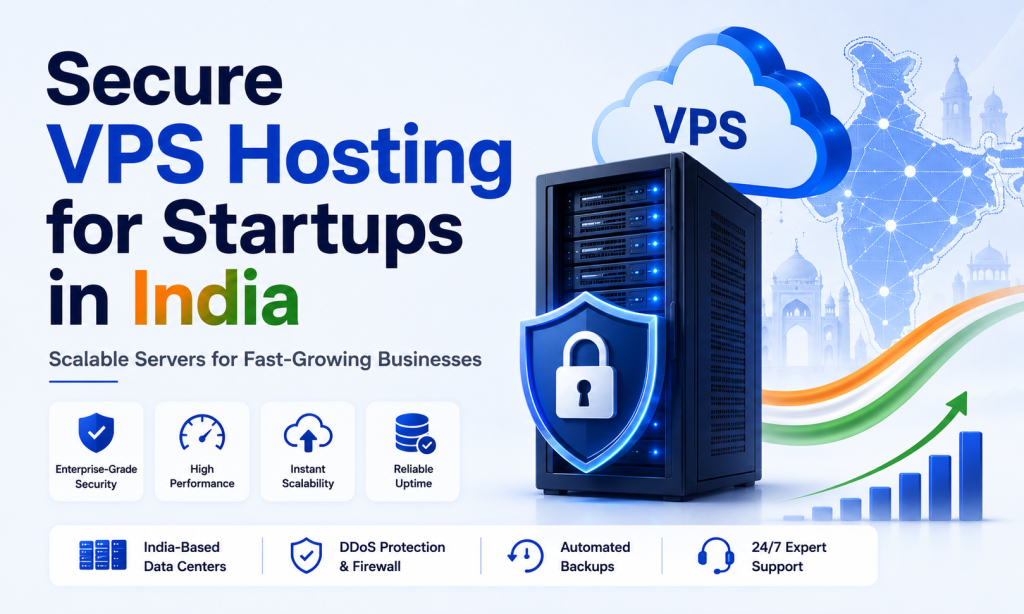
4. Key Performance Indicators (KPIs) for Server Selection
To choose a server that survives a “Product Hunt” launch or a viral social media trend, focus on these technical benchmarks:
- NVMe SSD Storage: Standard SSDs are fast, but NVMe (Non-Volatile Memory Express) drives offer significantly higher IOPS (Input/Output Operations Per Second). For database-heavy applications, NVMe is non-negotiable.
- Uplink Speed: Many budget hosts cap your port at 100Mbps. A fast-growing business needs at least a 1Gbps or 10Gbps port to handle concurrent user requests without queuing.
- Root Access & Environment Control: A startup needs the freedom to choose their stack—whether it’s Lemp (Linux, Nginx, MySQL, PHP), MERN (MongoDB, Express, React, Node), or a custom Python environment. Ensure your host provides full administrative (root) access.
- Dedicated IP Reputation: In shared environments, if a neighbor sends spam, your IP gets blacklisted. A VPS provides a dedicated IP, which is essential for email deliverability and SEO authority.
5. Navigating the Indian Regulatory & Economic Landscape
Choosing hosting services for startups in India involves more than just technical specs; it requires an understanding of the local ecosystem.
Data Residency and GDPR/DPDP Act
The Digital Personal Data Protection (DPDP) Act in India emphasizes the importance of where data is stored. Using a local server ensures you are compliant with future regulations regarding the storage of personal data belonging to Indian citizens.
Cost-Efficiency and the Rupee Factor
Many startups sign up for US-based cloud providers only to see their bills skyrocket due to currency fluctuations. Billing in INR (Indian Rupees) with a local provider like Ocloudi provides budget predictability, which is crucial for managing “burn rate” during the early years.
6. The Roadmap to Scaling: From MVP to Series A
Growth is rarely linear. Your hosting partner must be able to support you through three distinct phases:
Phase 1: The Minimum Viable Product (MVP)
At this stage, you need stability and low cost. A managed VPS with 2GB RAM and 1-2 vCPUs is usually sufficient. The goal is to get the product in front of users without worrying about server management.
Phase 2: User Acquisition & Traction
As traffic grows, you will see “bottlenecks” in your database. This is when you scale vertically—adding more RAM and vCPU to your existing VPS. A “Scalable Server for Fast-Growing Businesses” allows this transition with zero downtime.
Phase 3: The High-Availability Era
Once you reach a critical mass, a single server becomes a risk. You will move toward a multi-server architecture: one server for the web front-end, one for the database, and perhaps a load balancer to distribute traffic. Your VPS provider should offer private networking to allow these servers to communicate securely without exposing data to the public internet.
7. Expert Insight: The Fallacy of “Unlimited” Resources
In the hosting industry, the word “unlimited” is a red flag. Physical hardware always has limits. High-quality secure VPS hosting for startups will always define your resource limits (e.g., 40GB SSD, 4TB Bandwidth). This transparency ensures that you get exactly what you pay for, rather than sharing a “bottlenecked” resource with thousands of other users.
8. Why Ocloudi is the Strategic Choice for Indian Startups
Based in Delhi NCR, Ocloudi understands the friction points of the Indian tech scene. We don’t just provide “servers”; we provide the infrastructure that allows developers to focus on code rather than cooling systems or network routing.
- Strategic Proximity: Low-latency nodes across India ensure your app feels “instant” to your local user base.
- Human-Centric Support: When a deployment fails at 3 AM, you need an engineer, not a chatbot. Our support team is familiar with the specific challenges of Indian startups.
- Hybrid Scalability: Move between VPS and Cloud configurations as your business logic dictates.
Conclusion: Your Next Steps
Choosing the right server is a foundational business decision. A mistake here results in technical debt, security vulnerabilities, and lost revenue. For a startup, the priority is a balance between security, local performance, and predictable scaling.
Action Plan:
- Audit your current traffic: If you are on shared hosting and seeing “508 Resource Limit Reached” errors, move to a VPS immediately.
- Verify Data Location: Ensure your provider has hardware physically located in India to satisfy latency and compliance needs.
- Test the Support: Open a ticket with a technical question before buying. Their response time and quality are a preview of your future relationship.
Frequently Asked Questions (FAQ)
Managed VPS includes server maintenance, security patches, and software updates handled by the provider, which is ideal for startups without a dedicated DevOps team. Unmanaged VPS gives you the “blank slate” server where you are responsible for everything except the physical hardware.
Yes. Professional scalable servers allow for vertical scaling (adding RAM/CPU) or horizontal scaling (adding more servers). In a high-quality VPS environment, your data remains intact during the upgrade process, though a brief reboot might be required.
The primary reason is latency. A request from a user in Delhi to a server in Delhi takes ~10-30ms, whereas a request to a US server takes ~250-300ms. Furthermore, local servers help with compliance under India’s DPDP Act and offer billing in INR.
Yes, provided the VPS is “Hardened.” This includes implementing a Web Application Firewall (WAF), using SSH keys instead of passwords, and ensuring the provider offers hardware-level isolation and regular security audits.
Site speed is a confirmed Google ranking factor. Because a VPS provides dedicated resources, your site loads faster than on shared hosting. Additionally, a dedicated IP prevents your site from being associated with “bad neighborhood” sites that could hurt your reputation.
NVMe is a storage protocol designed for high-speed flash memory. It is significantly faster than traditional SATA SSDs. For startups running databases (MySQL, PostgreSQL) or high-traffic CMS platforms, NVMe reduces “disk wait” time, making the application feel much snappier.
A standard MVP or a corporate site usually starts well with 2GB to 4GB of RAM. If you are running heavy e-commerce platforms like Magento or complex SaaS applications, you should look at 8GB+ to ensure smooth concurrent processing.
Yes. As a SME-focused provider, Ocloudi allows for a variety of Linux distributions (Ubuntu, CentOS, Debian) and specific configurations required for specialized tech stacks.
With a scalable Cloud VPS, you can temporarily increase your resources to handle the load. Once the traffic subsides, you can adjust your plan back to normal levels, ensuring you only pay for what you use.